Best Wall Safe: In-Wall Safes With a Stated Steel Gauge, Thickest First
A wall safe's best feature is that nobody knows it's there; its second-best should be written on the spec sheet. This list keeps only wall safes that state their steel gauge, sorted from the thickest steel to the thinnest.
The list
10 models · checked weekly
The ruleWall safes with a stated steel gauge, sorted from thickest steel.
We earn a commission if you buy through our links, at no cost to you. Disclosure
10 models
Comparison tableSort by any column · tap a photo or name to open Amazon
One condition puts a wall safe on this list, and it has to be confirmed in writing by the manufacturer or the Amazon listing.
A stated steel gauge. The gauge of the body or housing, as a number.
The list is sorted by that gauge, thickest steel first. Where the maker gives a separate, thicker door gauge, the verdict mentions it, but the sort uses the body. The table shows the top ten that pass at our last check.
There is no editor's score and no popularity sort. These aren't wall safe reviews in the sense of someone prying at them. They're spec sheets, lined up by the one hard number every row has in common.
Why steel gauge is the yardstick for the best wall safe
A wall safe gives up a lot to stay hidden. It's shallow, it's light, and it's held in place by the studs it's fastened to. Most wall safes state no fire rating and no independent burglary rating, so the comparisons that work for floor safes and gun safes don't work here. Steel gauge is what's left, and most makers print it.
A lower gauge number means thicker steel. Under the federal U.S. Standard Gauge, 7-gauge is 0.1875 in, 10-gauge is 0.1406 in, 12-gauge is 0.1094 in, 14-gauge is 0.0781 in and 16-gauge is 0.0625 in. So a 7-gauge body is three times the thickness of a 16-gauge one.
What gauge doesn't tell you: how the door fits the frame, how the bolts engage, or what's behind the lock. Some safes on this list pair a thin body with a much thicker door. That's a reasonable design for a box whose sides are inside a wall and whose door is the only face anyone can reach. The verdicts note it where the maker states it.
Depth decides what fits your wall
Before any spec, check depth. A nominal 2x4 stud is actually 1½ x 3½ inches, according to the Southern Pine Inspection Bureau, so a standard 2x4 wall has about 3½ inches of cavity behind the drywall. A 2x6 wall has about 5½ inches.
That splits this list in two.
Shallow bodies, around 3½ to 4 in. Made to sit between studs in an ordinary wall. Some of these are a little deeper than 3½ in; check the manual for how much of the face sits proud.
Deep bodies, around 10 in. The thickest steel on this page comes in these. They need a deeper wall, a built-out wall, or a spot where the safe can sit into a closet or cabinet behind.
On this list, the thickest steel comes in the deepest bodies. If your wall is a 2x4 and you don't want to reframe, the top rows may not be for you. That's a trade-off, not a flaw.
How to read the list
Steel gauge. Body first. "—" never appears in this column here, because a stated gauge is the rule.
Exterior depth. Compare with your wall cavity before anything else.
Interior dimensions. Height, width and depth inside. Wall safes are shallow, so interior depth can be under 3 in. Measure what you plan to store.
Lock and backup. Keypad, dial or fingerprint, and whether there's a backup key. Where a backup key isn't confirmed, the verdict says so; read the manual before you count on one.
Fire rating. At our last check, none of these claims one. A stud cavity leaves little room for insulation.
Sources matter. Where the manufacturer and the Amazon listing disagree on size or material, we keep the manufacturer's value and say so in the verdict. Where two listings disagree and the maker is silent, the field stays empty.
Installing a wall safe: what the spec sheet skips
A wall safe is only as fixed as the studs it's fastened to. The installation is where most of its security comes from, and the listing rarely says much about it.
The general steps, as This Old House describes them: find the studs, cut a small inspection hole to check for wiring and pipes, then cut the opening to the size in the manual. The safe goes in between the studs and is fastened to them with the screws or lag bolts provided. Follow the manufacturer's instructions for the specific model, since flange sizes and fastener counts differ.
A few things worth checking before you cut:
Stud spacing. Some safes are built for studs on 16 in centers. If your wall differs, the safe may need blocking.
What's in the bay. Wiring, plumbing and ductwork all live in walls. An inspection hole costs less than a repair.
Renting. Cutting into a wall needs the owner's permission.
Placement matters as much as the safe. Police burglary-prevention advice warns against keeping valuables in nightstands, dressers, desks and closets. A wall safe behind something ordinary, in a less obvious room, does more of its job.
Biometric wall safes: check the model
Fingerprint wall safes are quick to open, which is the point for many buyers. Since 2023 the CPSC has announced recalls and warnings for several biometric gun safes because the fingerprint lock could open for unauthorized users, including a January 2025 warning covering about 183,000 Stack-On units. Check the model number against CPSC notices, choose a model with a backup key, and keep that key away from the safe.
What's not in the list, and why
Wall safes with no stated gauge. The rule needs the number. Some wall safe listings state only "steel."
Diversion safes. Fake outlets, books and vents aren't wall safes, even when they hang on a wall.
Gun cabinets that mount on a wall. They're on the wall gun safes page.
Unavailable products. Anything not live on Amazon US at our last check drops out and returns when it's back.
Amazon's own brands. Never included on this site.
Products change from week to week. The rule stays the same.
Who should look elsewhere
You want every wall safe, gauge stated or not. The wall safes type page lists all of them and covers installation.
You're storing a handgun or long gun.Wall gun safes includes gun safes and cabinets that mount in or on a wall.
You need a fire rating. A wall cavity is the wrong place for it. Floor safes and fire-rated home safes are the better fit.
You care most about staying hidden.Hidden safes and the hidden safe ideas guide cover placement and diversion options.
Wall safe or floor safe?
The two solve the same problem in different places. A wall safe is easy to reach and easy to hide behind a picture or a panel. It's also shallow, light and held by the studs. A floor safe sits in or on the floor, can be much heavier, and is harder to reach for anyone, including you.
If you need daily access to a handgun, keys or cash, a wall safe at standing height is practical. If you're storing something you rarely touch and want it as hard to remove as possible, a floor safe is worth comparing. Either way, check the listing for a stated burglary rating before comparing anything else.
Measure the wall cavity first. Then pick the thickest steel that fits, and keep the location to yourself.
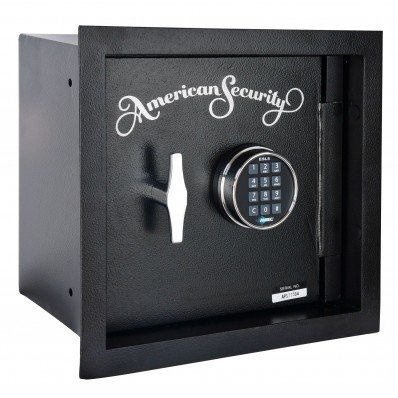
Fire rating: none stated by AMSEC. Steel: 7-gauge. Interior: 12.25 x 13.63 x 5.25 in; the body is 10 in deep. Lock: ESL5 electronic keypad; backup key not confirmed; three 1-inch bolts plus a dead bar, hard plate and relocker. The thickest steel on this page by a wide margin.
Buy it ifyou have a deep wall or a framing plan and want 7-gauge steel with a hard plate and relocker.
Skip it ifyou're working with a standard 2x4 wall; a 10 in body needs a deeper wall or framing work.
Fire rating: none claimed. Steel: 10-gauge housing, per XDeer. Interior: 8.7 x 11.6 x 3 in per XDeer; Amazon's bullets give smaller numbers. Lock: fingerprint, keypad and backup key, plus a USB emergency port. Drop-down door on a gas strut, made for quick access. Weight not confirmed.
Buy it ifyou want a wall-mounted safe with fingerprint, keypad and key access and a gas-strut drop-down door.
Skip it ifyou want a safe that sits inside the wall cavity; this one bolts to the wall.
Fire rating: none claimed. Steel: 10-gauge laminated shell, per XDeer. Interior: not stated; outside 22.04 x 16.22 x 4.13 in per Amazon. Lock: fingerprint (20 prints), keypad and backup key. Fits between studs on 16 in centers, per XDeer. The only in-wall biometric safe here.
Buy it ifyour studs are on 16 in centers and you want fingerprint access in an in-wall safe.
Skip it ifyour wall is a 2x4; XDeer's own install depth is 3.93 in, so check the manual for how far it sits proud.
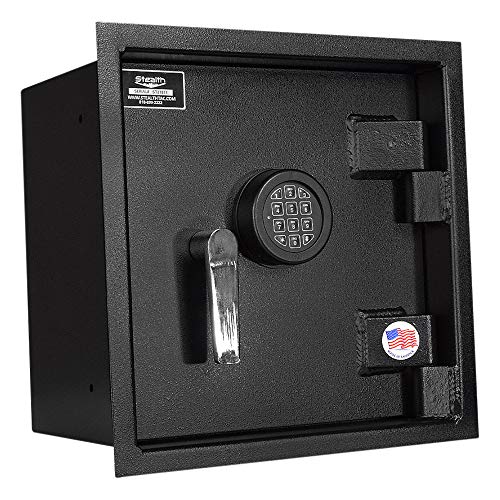
Fire rating: none claimed. Steel: 12-gauge body, 1/2 in steel plate door, per Stealth. Interior: 13.63 x 13.63 x 5 in; body 10 in deep. Lock: UL-listed electronic keypad lock, per Stealth; backup key not confirmed; three 1-inch bolts. Stealth states it is made in the USA. Half an inch of door plate, in a body that needs a deep wall.
Buy it ifyour wall is deeper than a 2x4 and you want a 1/2 in steel plate door with a keypad.
Fire rating: none claimed. Steel: 12-gauge body, 1/2 in steel plate door, per Stealth. Interior: 13.63 x 13.63 x 5 in; body 10 in deep. Lock: UL-listed mechanical dial, per Stealth; no batteries. The same safe as the row above with a dial instead of a keypad. Made in the USA, per Stealth.
Buy it ifyou want a 1/2 in steel plate door and a UL-listed dial that runs without batteries, per Stealth.
Skip it ifyou need to open it in seconds; dials reward patience, not hurry.
Fire rating: none stated by AMSEC. Steel: 14-gauge. Interior: 20.88 x 13.75 x 2.88 in; the body is 4 in deep. Lock: DL6000 keypad with emergency key override; two live bolts; two removable shelves. The Amazon title says "Plastic" and lists other dimensions; AMSEC says steel, and we went with AMSEC.
Buy it ifyou need a 4 in deep body with a keypad, an emergency key override and two removable shelves.
Skip it ifyou need more than 2.88 in of interior depth.
Fire rating: none claimed. Steel: 16-gauge body, 8-gauge door, per SnapSafe. Interior: 19.7 x 11.8 x 3.6 in, per the Amazon listing. Lock: keypad with backup key; 4 AA batteries; door opens left or right. Mounts between two studs with six lag bolts. Magnetic key hooks and a document holder on the door.
Buy it ifyou want an 8-gauge door that opens left or right, with key hooks and a document holder behind it.
Skip it ifbody steel matters more to you than door steel.
Fire rating: none claimed. Steel: 16-gauge body, 8-gauge door, per SnapSafe. Interior: not confirmed; two Amazon listings disagree. Outside 44 x 16.25 x 4 in, 66 lb. Lock: keypad with backup key. Tall enough for a long gun, between two studs. The only full-height wall safe in this list.
Buy it ifyou want a long gun inside the wall between two studs, behind an 8-gauge door.
Skip it ifyou need a confirmed interior length before you cut drywall.
Fire rating: none; Tracker calls it non-fire insulated. Steel: 16-gauge body, 11-gauge door. Interior: 20.5 x 12.5 x 2.38 in, 0.35 cu ft; the 0.60 cu ft in the Amazon title is the outside. Lock: keypad with two override keys; two 0.75 in bolts; ten key hooks. The shallowest body here, at 3.63 in.
Buy it ifyou want ten key hooks and folder space in a body just 3.63 in deep.
Skip it ifyou need room for anything thicker than a folder.
One that fits your wall cavity, states its steel gauge, and has a lock with a usable backup. This list sorts wall safes by stated gauge, thickest first. Check the body depth against your wall before comparing anything else.
What is the best hidden wall safe?
The one that sits flush inside the wall and is covered by something ordinary. A body that fits within the cavity sits flatter than one that sticks out. Placement matters as much as the safe: avoid the obvious rooms and keep the location to yourself.
Are biometric wall safes a good idea?
They open quickly, which suits a handgun or daily-use items. Choose one with a backup key and a way to power the lock from outside if the batteries die. Since 2023, the CPSC has recalled or warned about several biometric gun safes, so check the model number before you buy.
Are wall safes fire-resistant?
None of the wall safes on this list claims a fire rating. A stud cavity leaves little room for insulation. If fire protection matters, look at fire-rated floor or home safes instead.
Will a wall safe fit a 2x4 wall?
Only if its body is about 3.5 in deep or less, because that is the actual depth of a nominal 2x4. Deeper safes need 2x6 framing, a built-out wall, or a face that sits proud of the wall.
Are these wall safe reviews based on testing?
No. This page compares what manufacturers and Amazon listings state: steel gauge, dimensions, lock and backup. We don't test safes. Where sources disagree, the verdict says so, and where a value isn't stated, the table shows a dash.