Best Money Safe: Safes for Cash, Sorted by Fire Rating, Then Steel
Cash has two enemies at home, and only one of them can read a listing. This list keeps home safes, floor safes and lock boxes whose fire-rating status is confirmed, sorted by fire rating, longest first, then by steel thickness.
The list
10 models · checked weekly
The ruleHome safes, floor safes and lock boxes with a confirmed fire-rating status, sorted by fire rating, then steel thickness.
We earn a commission if you buy through our links, at no cost to you. Disclosure
10 models
Comparison tableSort by any column · tap a photo or name to open Amazon
The rule: a confirmed fire status, then fire rating and steel
One condition puts a safe on this list, and it has to be confirmed in writing by the manufacturer or the Amazon listing.
A confirmed fire-rating status. The maker or listing says the safe is fire-rated, or says it isn't. Safes that say nothing either way are left out.
The rule covers home safes, floor safes and lock boxes. They're sorted by stated fire rating, longest first. Safes with the same rating are sorted by steel thickness, thickest first. A safe that's confirmed as not fire-rated can still qualify; it just sorts below every fire-rated one.
The table shows the top ten at our last check. There's no editor's score, no popularity and no "best value" badge. A higher row means a longer stated fire rating, or thicker steel at the same rating.
Why fire comes first in the best safe for cash
Cash at home faces two risks. Theft gets the attention. Fire is the other one, and paper money is paper. A safe that keeps a burglar out but lets the inside reach paper-charring temperatures has done half the job.
So the sort starts with fire rating, and it shows who issued each one.
Rated by a lab. UL or ETL. UL describes a fire rating as a class plus a time. Class 350 means the inside stayed under 350°F, and UL says that class is intended to protect paper records.
Claimed by the maker. "Factory tested" or "tested in-house," with no lab named. It may well be accurate. It just hasn't been checked by anyone else, as far as the listing says.
Read the source before the number. A 2-hour claimed rating and a 2-hour UL rating sit next to each other in this table, sorted the same. They aren't the same kind of promise.
Steel comes second because, at the same fire rating, thicker steel is the clearest remaining difference you can read off a spec sheet. A lower gauge number means thicker steel: under the federal U.S. Standard Gauge, 12-gauge is 0.1094 in and 16-gauge is 0.0625 in. Many rows in this table don't state gauge at all, so this second sort often has little to work with.
Burglary ratings: the column to read next
The rule doesn't require a burglary rating, but the table shows one wherever it's stated. For cash, that column deserves a long look.
UL RSC (Residential Security Container). Under UL 1037, a Level I RSC must resist a 5-minute attack by one person with common hand tools and a small electric drill, without the door opening or a 4-inch hole being made.
UL TL-15. A burglary class under UL 687. A TL-15 safe resisted 15 minutes of net working time by expert attackers with tools, without the door opening or a 6-square-inch opening being made through the door or front face.
A burglary label says nothing about fire, and a fire label says nothing about burglary. At our last check, some rows here carry one, a few carry both, and several carry only a fire rating. The best safe for the money, in the literal sense, is the one whose labels match what you're actually worried about.
How to read the list
Fire rating. Minutes, outside test temperature, and who issued it. Temperature is the furnace, not the inside of the safe.
Water rating. A separate claim. Hours, depth and who tested it. Two listings for the same model can disagree on depth; where they do, the verdict says so.
Interior. Dimensions or cubic feet. Some titles quote the outside volume as if it were the inside. Where we caught that, the interior shows "—" and the verdict explains.
Lock and backup. Dial, keypad or both. Where a backup key isn't confirmed, the verdict says so.
Weight. Heavier is harder to carry off, but nothing replaces bolting it down.
"—" means nobody we found put that value in writing. It isn't zero, and it isn't a guess.
Size: buy for the cash and the papers next to it
Most people who buy a money safe end up storing more than money. Passports, titles, a watch, a spare set of keys. A safe sized exactly for a stack of bills fills up fast.
Read the interior dimensions, not just cubic feet. A tall, shallow interior holds folders; a short, deep one holds boxes. Shelves take space, and so does a door with a thick fire seal. Where a title quotes a cubic-foot figure that matches the outside of the box, the table shows "—" for capacity and the verdict says so.
Anchoring and placement: the part no rating covers
Every rating on this page assumes the safe stays where you put it. A light safe that isn't bolted down can be carried off whole and opened somewhere quieter. The weight column helps, but at our last check the safes here ran from under 100 lb to over 500 lb, and only some of that range is hard to move.
Most safes in this table come with pre-drilled holes or bolt-down hardware. Use them. The hardware in the box is a starting point; the right anchor depends on whether you're bolting into concrete or a wood subfloor, and the manual will say what the kit is meant for.
Placement matters too. The FBI's 2025 figures put residential properties at 53.4% of all burglary offenses, and its incident data shows burglaries reported most often between noon and 5:59 p.m. A safe in the first closet anyone would check is easy to find. A safe in a less obvious spot, anchored, buys time.
Keep the backup key and the combination somewhere other than the safe's own room. A key taped under the drawer next to the safe isn't a backup. It's a second way in.
What's not in the list, and why
Safes with no stated fire status. A listing that never mentions fire one way or the other doesn't pass.
Diversion safes and wall safes. They're built to hide, not to rate. They have their own pages.
Gun safes. Some hold cash well, but they aren't in this rule's types.
Unavailable products. Anything not live on Amazon US at our last check drops out and returns when it's back.
Amazon's own brands. Never included on this site.
Products change from week to week. The rule doesn't.
Who should look elsewhere
You want every money safe, rated or not. The money safes type page lists all of them with filters.
You keep a small cash float, not savings.Money lock boxes are lighter and simpler.
Theft is the main concern.Burglary safes lists only safes with a stated burglary rating. Floor safes are harder to reach and remove.
Fire is the main concern.Fire-rated home safes shows only safes with a stated fire rating.
Whatever you choose, anchor it. The bolting guide covers floors, anchors and renters. Then write the combination down somewhere that isn't the safe's own door.
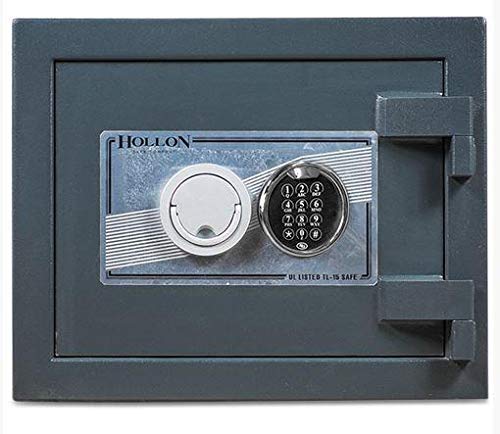
Fire rating: 2 hours at 1,750°F, claimed by Hollon as factory tested; no lab named. Burglary: UL TL-15, per Hollon. Interior: 10.5 x 14 x 10.5 in, 0.89 cu ft; 450 lb. Lock: combination dial; hard plate and glass relocker. The fire number is the maker's; the burglary rating is UL's.
Buy it ifyou want a UL TL-15 burglary rating behind a combination dial with a hard plate and glass relocker.
Skip it ifyou want an independent fire rating, or can't get 450 lb through the door.
Fire rating: 2 hours at 1,750°F, claimed by Hollon as factory tested; no lab named. Burglary: UL TL-15, per Hollon. Interior: 10.5 x 14 x 10.5 in, 0.89 cu ft. Lock: S&G Spartan electronic keypad; backup key not confirmed. Same body as the dial version above. Weight: Hollon says 450 lb; one Amazon attribute says 297.7.
Buy it ifyou want the same UL TL-15 body with an S&G Spartan keypad instead of a dial.
Skip it ifyou'd rather not rely on batteries; the dial version is the row above.
Fire rating: 2 hours at 1,750°F, claimed by Hollon as factory tested; no lab named. Burglary: UL TL-15, per Hollon. Interior: 18 x 14 x 9.5 in, 1.39 cu ft; 575 lb. Lock: UL-listed Group 2M dial. The roomiest TL-15 on this page, and the heaviest object in the table.
Buy it ifyou want the roomiest TL-15 here, 1.39 cu ft, with a UL-listed Group 2M dial.
Skip it ifyour floor, stairs or movers aren't ready for 575 lb.
Fire rating: 2 hours at 1,850°F, UL Classified per the Amazon listing; class not printed. Water: 24 hours in 5 in of water, ETL, per the listing. Interior: 9.6 x 12.6 x 11.5 in, 0.82 cu ft; 97 lb. Lock: keypad; backup key not confirmed; three 1-inch bolts. An independent fire rating at under 100 lb.
Buy it ifyou want a UL Classified fire rating and an ETL water rating in a 97 lb safe.
Skip it ifyou want a burglary rating; none is stated.
Fire rating: 2 hours at 1,850°F, UL Classified per the Amazon listing; class not printed. Water: 24 hours in 5 in of water, ETL, per the listing. Interior: not stated; 1.23 cu ft per the title; 128 lb. Lock: combination dial, no batteries; three 1-inch bolts. The dial version of the 1.2 cu ft Master Lock.
Buy it ifyou want the UL Classified fire rating with a combination dial and no batteries to replace.
Skip it ifyou need interior dimensions before buying; the listing gives volume only.
Fire rating: 2 hours at 1,850°F, UL Classified per the Amazon listing; class not printed. Water: 24 hours in 5 in of water, ETL, per the listing. Interior: 13.8 x 12.6 x 11.9 in, 1.2 cu ft; 128 lb. Lock: keypad; backup key not confirmed. Same rating as its smaller sibling, with room for stacked folders.
Buy it ifyou need 1.2 cu ft for stacked folders under a UL Classified fire rating.
Skip it ifyou want a stated burglary rating or a confirmed backup key.
Fire rating: 2 hours at 1,850°F, UL Classified per the Amazon listing; class not printed. Water: 24 hours, ETL; 8 in deep per Master Lock, 5 in per Amazon. Interior: 19.6 x 14.8 x 11.9 in, 2.0 cu ft; 192 lb. Lock: keypad; six 1-inch bolts and a hinge bar. The largest Master Lock here.
Buy it ifyou need 2.0 cu ft, six 1-inch bolts and a hinge bar under a UL Classified fire rating.
Skip it ifyou only keep an envelope of cash; it's a lot of safe for that.
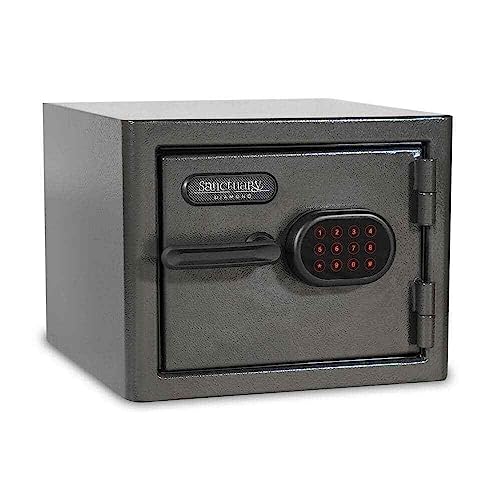
Fire rating: 90 minutes at 1,800°F, claimed by SA Consumer Products; no lab named. Water: 7 days "up to handle," also claimed. Interior: 0.75 cu ft per the maker. Lock: keypad with backup keys; 16-gauge steel. Lifetime warranty covering theft, fire, flood, locks, parts and paint, per the maker. Weight: 54 lb per the maker, 30 lb per Amazon.
Buy it ifyou want keypad backup keys and a lifetime warranty that names theft, fire and flood, per the maker.
Skip it ifyou want an independent fire or water rating.
Fire rating: 60 minutes at 1,200°F, claimed by Stealth; no lab named. Burglary: UL RSC, per Stealth. Interior: 21 x 15 x 13 in; 191 lb. Lock: keypad; Stealth and Amazon name different lock models. 12-gauge steel, 1.25 in bolts, three outlets and two USB ports inside. A burglary rating plus a power strip.
Buy it ifyou want a UL RSC burglary rating, 12-gauge steel and power outlets inside, per Stealth.
Skip it iffire is your main concern; 1,200°F is the lowest test temperature here.
One that is anchored, states a fire rating with the time, temperature and who tested it, and has a lock you will use correctly. If theft is your main worry, look for a stated burglary rating such as UL RSC or TL-15. This page sorts by fire rating, then steel, and shows the burglary rating where one is stated.
Do cash safes need a fire rating?
Paper money is paper, so a fire rating matters for cash as it does for documents. A UL Class 350 rating is intended to protect paper records. Many safes state only a claimed rating with no lab, so check the table for who issued each one.
What does TL-15 mean on a money safe?
TL-15 is a burglary class under UL 687. A TL-15 safe resisted 15 minutes of net working time by expert attackers with tools, without the door opening or a 6-square-inch opening being made through the door or front face. It is a higher class than the UL RSC rating common on gun safes.
How much cash should I keep in a home safe?
That is a personal and financial decision, and we don't advise on it. What we can say is that the safe's fire rating, burglary rating and anchoring should match what you store. Your homeowners or renters policy states what it covers for cash; read it before you decide.
Is a lock box enough for cash?
For small amounts kept out of casual reach, a lock box can be enough. Most lock boxes are light, easy to carry and rarely fire-rated. For larger amounts, an anchored safe with a stated fire rating is the better match.
Is a floor safe better than a home safe for cash?
A floor safe is harder to reach and remove once installed, which suits cash you don't need often. A home safe is easier to install and to open daily. Compare the stated fire rating, burglary rating and anchoring rather than the type name.